eISSN: 2373-6372


Case Report Volume 16 Issue 4
1Department of Medicine Soba University Hospital, Sudan
2Department of Surgery Soba University Hospital, Sudan
3Department of Radiology Soba University Hospital, Sudan
4Department of Histopathology, Soba University Hospital, Sudan
Correspondence: Hatim MY Mudawi, Department of Medicine, Soba University Hospital, Khartoum, Sudan
Received: July 24, 2025 | Published: October 14, 2025
Citation: Elsir AT, Abdelgadir AAM, Bahar MEH, et al. Jejunal gastrointestinal stromal tumour presenting with recurrent melena: a case report. Gastroenterol Hepatol Open Access. 2025;16(3):132-133. DOI: 10.15406/ghoa.2025.16.00621
Background: Gastrointestinal stromal tumours (GIST) are rare, representing less than 3% of all gastrointestinal malignancies with approximately 30% of GIST’s located in the small bowel. Common symptoms include abdominal discomfort, weight loss and gastrointestinal bleeding.
Case presentation: We describe a case of a 38-year-old lady presenting with recurrent melena, and normal upper and lower GI endoscopy where Computed Tomography Angiography revealed an exophytic jejunal mass. Following surgical resection, histopathology and immunohistochemistry confirmed the diagnosis of jejunal GIST.
Conclusion: Small intestinal GIST is a rare cause of gastrointestinal bleeding, in this case multidisciplinary team approach by gastroenterology, radiology, surgery, histopathology and oncology were the corner stone in successful management.
Keywords: Jejunal tumours, GIST, GI Bleeding
Gastrointestinal stromal tumours (GISTs) are rare neoplasms accounting for less than 3% of all gastrointestinal malignancies, they arise from spindle shaped mesenchymal cells, known as interstitial cells of Cajal or their stem cell precursors.1 Most GISTs are found in the stomach or the small intestine accounting for approximately 40-60 % and 30% respectively.2
A 38-year-old lady presented to a local hospital with an episode of melena, she had no abdominal pain, hematemesis or weight loss. She was admitted to hospital, and transfused two units of blood and an upper and lower GI endoscopy were normal. After three months, she had another episode of melaena and was again transfused with two units of blood and repeat upper and lower endoscopy were normal. Two months later she developed a third episode of melena and was transferred to Soba University Hospital in Khartoum. On admission she was pale, but vitally stable and physical examination was otherwise unremarkable. Investigations revealed a haemoglobin of 6.1 g/dl, low MCV, normal TWCC, platelets and coagulation profile. She was transfused with two units of blood and underwent an urgent Computerized Tomography Angiography CTA (Figure 1); this showed an 8.0 x 4.6 x 4.8 cm exophytic mass in the small bowel with no evidence of intestinal obstruction or intussusception She underwent a laparotomy which revealed an 8.0 x 6.0 cm, round jejunal mass at the anti- mesenteric border, 60.0 cm from the duodenojejunal flexure, reddish in colour with multiple vascular pedicles at the base (Figure 2). The base was freely mobile with no attachment to adjacent bowel structures or to the anterior abdominal wall, resection with 2.0 cm free margin was done with side-to-side anastomosis. Histopathology of the lesion (Figure 3) showed a vascular tumour composed of spindle cells in loose interlacing bundles with < 5 mitosis/50 HPF, it was ulcerating the outline mucosal lining, but the serosa was intact and not breached. Immunohistochemistry revealed neoplastic cells which were diffusely positive for CD117 and Dog-1, and focally positive for SMA, this confirmed the diagnosis of GIST. The tumour was classified as intermediate risk tumour in view of its location, size and mitotic count. The patient was referred to the oncology department for adjuvant therapy and received Imatinib 400 mg once daily. She was reviewed six months later and was asymptomatic with no evidence of tumour recurrence.
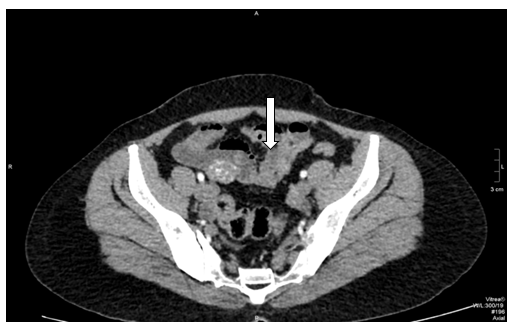
Figure 1 Computerized Tomography Angiography of the abdomen showing well defined right iliac fossa exophytic mass 8.0 x 4.6x 4.8 cm inseparable from adjacent small bowel loops with preserved cleavage lines and enhancement with intravenous contrast with no evidence of necrosis or distant metastases.
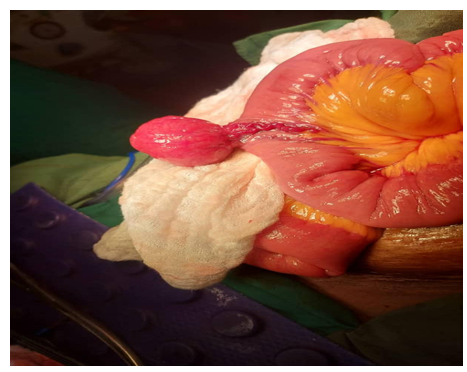
Figure 2 Intraoperative photo showing 8.0x6.0 cm jejunal mass, 60 cm from the duodenojejunal flexure, with multiple vascular pedicles at the base.
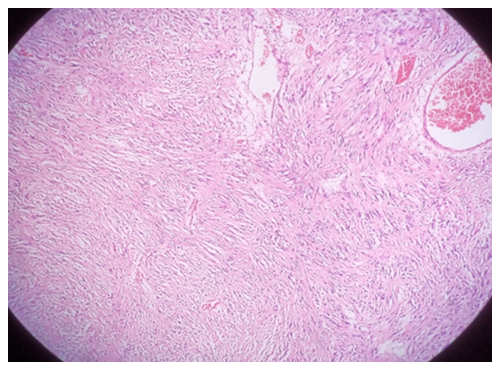
Figure 3 Haematoxylin & Eosin staining showing spindle cell morphology consistent with GIST.
GIST tumours are equally distributed among males and females; although some studies report slight male predominance. Median age at diagnosis is 60-65 years,1-3 with more than 90% of cases occurring in those above the age of 40 years, while presentation in young adults between 18-40 years occurs in 5-10% of cases.4 Small bowel GIST is more common in young adults occurring in approximately 46% of cases compared to 28% in older patients, with 5- year survival of up to 85% of young adults in comparison to 76% survival in older patients.4 Small intestinal GIST’s may present with anaemia, abdominal pain, intestinal obstruction and gastrointestinal bleeding.1,3 Diagnosis of small bowel GISTs may be delayed because of non-specific symptoms, presence of overlapping loops of intestine making imaging interpretation difficult. CT A is a very valuable tool in identification of site of bleeding in small bowel GIST’s.5 The aggressiveness of GISTs depends on the size and mitotic index of the tumour, anatomic site and age of the patient.1The National Institute of Health GIST consensus criteria, has divided these tumours into four groups: very low risk, low risk, intermediate risk and high risk.6 GISTs in the small bowel are usually more aggressive and associated with worse prognosis and more recurrence rates than gastric GISTs of similar size and mitotic index.1 Surgery is the treatment of choice for localized GISTs, lesions > 2.0cm and those with features of malignancy on endoscopic ultrasound. Other therapeutic modalities include endoscopic resection, chemoembolization, radiofrequency ablation and adjuvant Imatinib.1,3 Mutation analysis is important in decision making regarding use of adjuvant therapy, young adults have less mutations in KIT and PDGFRA receptor tyrosine kinase genes than older adults, some mutations in KIT/ PDGFRA genotypes are resistant or less sensitive to Imatinib.7 In view of location of the tumour and classification as intermediate risk tumour, and the fact that up to 30% of small bowel GIST may recur post-operatively, the patient was started on Imatinib 400 mg once daily with good effect. Although surgical resection and tyrosine kinase inhibitor adjuvant therapy proved successful in this single case report, prognosis and treatment outcomes cannot be generalized.
Small intestinal GIST is a rare cause of gastrointestinal bleeding, in this case multidisciplinary team approach by gastroenterology, radiology, surgery, histopathology and oncology were the corner stone in successful management. CTA is valuable in reaching a diagnosis in patients with melena when upper and lower GI endoscopy are normal
None.
None.

©2025 Elsir, et al. This is an open access article distributed under the terms of the, which permits unrestricted use, distribution, and build upon your work non-commercially.
