Journal of
eISSN: 2572-8466


Proceeding Volume 8 Issue 4
State University of New York, USA
Correspondence: Umair Masood, State University of New York, USA
Received: July 29, 2021 | Published: August 24, 2021
Citation: Masood U. Identification of a gene that makes a protein by using a cell free protein synthesis system. J Appl Biotechnol Bioeng. 2021;8(4):124-125. DOI: 10.15406/jabb.2021.08.00264
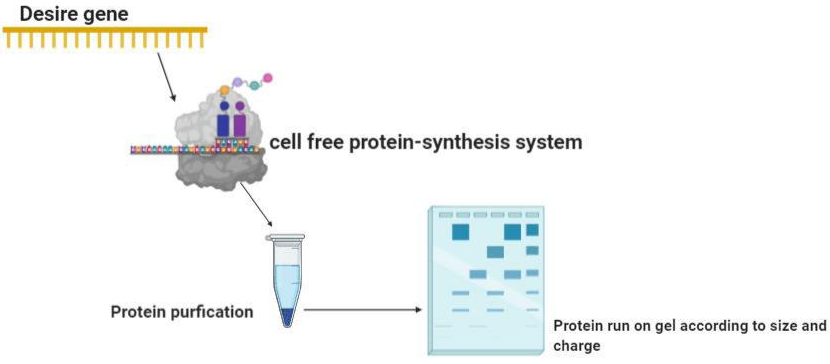
A living cell could be genetically modified to perform a function such as the production of a protein. However, these genetic modifications often conflict with normal cellular function and result in a mutation. Defects can be overcome through removing the bacterial membrane which leaves the lysate that is performing both transcription and translation. The cell free-protein synthesis is also known as in vitro protein synthesis and is the production of a protein without using a living cell. The gene is acting as instructions to make the protein. If we can isolate a gene and then apply a cell free protein synthesis system after synthesis the protein and run on gel-electrophoresis we can identify a gene on the basis of the protein. Gel electrophoresis is a laboratory technique used to ______ contrasting proteins according to molecular size and charge.
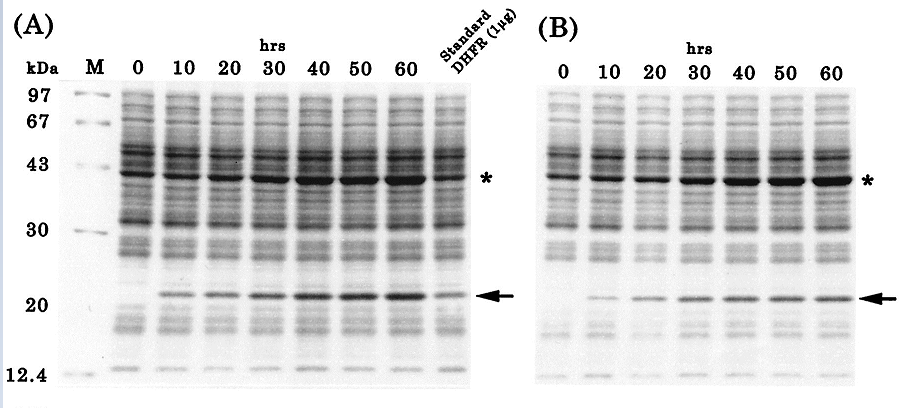
Protein blends in the dialysis framework. (A and B) Coomassie blue-stained SDS polyacrylamide gels showing DHFR blend with (A) or without (B) expansion of new mRNA. Bolts and indicators mark DHFR and creatine kinase, individually. The standard example was ready by blending a response combination without mRNA with known measures of DHFR prior to stacking onto the gel.
None.
The author declares that there is no conflict of interest.
None.

©2021 Masood. This is an open access article distributed under the terms of the, which permits unrestricted use, distribution, and build upon your work non-commercially.