Journal of
eISSN: 2373-6437


Editorial Volume 17 Issue 5
1Researcher without Institution, Rio de Janeiro, RJ, Brazil and Anesthesiology Consultant at Somosalle group, Brazil
2Professor, Department of Anesthesiology, Rohailkhand medical College and Hospital, India
3Anesthesiologist at the National Cancer Institute (INCA), India
4Head of the Anesthesiology Service of the National Cancer Institute (INCA) Anesthesiologist, Responsible for the CET-SBA of the National Cancer Institute, Brazil
5Professor of Anesthesiology at the UFG Faculty of Medicine, Responsible for the CET-SBA of the HCUFG, Brazil
Correspondence: Luiz Eduardo Imbelloni, MD, PhD, Researcher without Institution, Rio de Janeiro, RJ, Brazil and Anesthesiology Consultant at Somosalle group, Av. Epitácio Pessoa, 2356 - Apto 203, Lagoa, 22411-072 – Rio de Janeiro, RJ, Brazil, Tel + 55.11.99429-3637
Received: October 10, 2025 | Published: October 23, 2025
Citation: Imbelloni LE, Chandra R, Rivoli ALC, et al. Differences between the sitting position, lateral decubitus positions, prone position for spinal anesthesia. Importance of teaching all positions. J Anesth Crit Care Open Acces. 2025;17(4):136-138. DOI: 10.15406/jaccoa.2025.17.00635
The first six spinal anesthesia’s performed by Bier in 1898 and published in 1899 were with the patient in a lateral position and Quincke needle for lumbar puncture (Original German: Bei dem in Seitenlage befindlichcn Kranken wird die Quinckesche Lumbalpunktion in bekannter Weise vorgenommen).1 The first clear documentation of the use of the sitting position for spinal anesthesia appears to be by Alexandru Tzaicu, in 1909, and published in 1911.2
I recently wrote three articles addressing the various puncture positions,3 safety in spinal anesthesia4 and spinal anesthesia is much more than a single injection of 0.5% hyperbaric bupivacaine.5 There are two schools that teach and practice neuraxial puncture for both spinal anesthesia, with the patient in the sitting position (most in the world) and with the patient in the lateral decubitus position. I believe that teaching in the lateral decubitus position has the possibility of performing other positions such as sitting, supine position, as some old orthopedic tables have a space between the back and the gluteal region of the patients through which the spinal needle will enter.6
Those who prefer to teach and perform in a sitting position have the following explanations: easier identification of reference points, better control of the dispersion of the hyperbaric anesthetic, greater safety in obese patients and those with scoliosis, better patient coordination, reduced risk of failure. In several aspects, the three puncture positions for spinal anesthesia, sitting (Figure 1), left lateral decubitus (Figure 2) and ventral decubitus (Figure 3), were compared showing the advantages and disadvantages (Table 1).
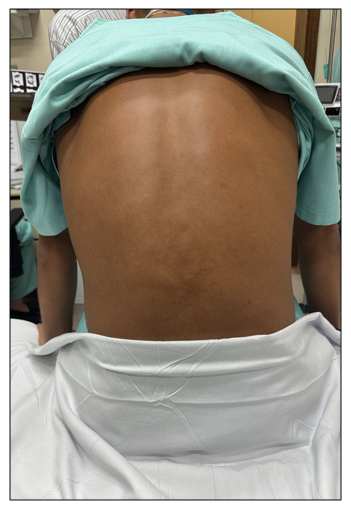
Figure 1 Sitting position for spinal anesthesia, with legs extended on the surgical table and anesthetist at the head of the table.
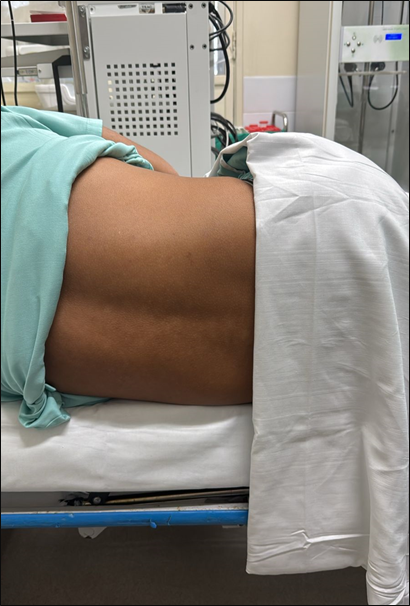
Figure 2 Left lateral decubitus for spinal anesthesia, with an anesthetist sitting on a bench.
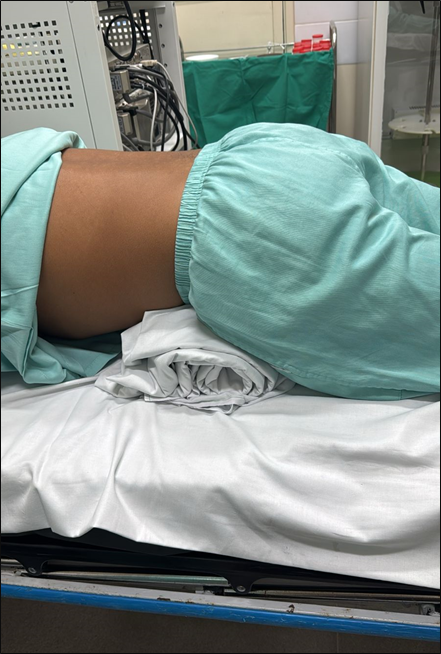
Figure 3 Jack-knife position for posterior spinal anesthesia, with anesthesiologist standing on the patient's left side.
|
Aspect |
Sitting Position |
Lateral Decubitus |
Ventral Decubitus |
|
Description |
Sitting torso flexed, feet supported |
Lying on their side, knees bent and chin close to the chest |
Prone with hips elevated and pillow on iliac crest |
|
Identification of spaces |
Greater visibility and palpation |
More difficult obese, pregnant |
Greater visibility |
|
Opening spaces |
Better lumbar flexion |
Smaller opening spaces |
Well-exposed spaces |
|
Patient stability |
Less stable |
More stable and safer |
Excellent stability |
|
Patient comfort |
Uncomfortable pain and elderly |
More comfortable and safe |
Comfortable and safe |
|
Anesthetic distribution |
Influenced by gravity (sacral) |
Favors asymmetric blockade |
Favors the perianal, sacral |
|
Patient cooperation |
Requires greater collaboration |
Less collaboration required |
Comfortable, cooperative |
|
Risk vasovagal syncope |
Higher risk |
Lower risk of syncope |
No risk of syncope |
|
Typical applications |
Difficult anatomical situations |
Sedation, trauma, elderly |
Anorectal surgeries |
|
Sedation |
Heavy, needs help |
Light, doesn't need help |
Light, doesn't need help |
|
Needs help |
Needs someone to hold |
Doesn't need anyone |
Doesn't need anyone |
Table 1 Aspects of the comparison between sitting, lateral decubitus puncture and ventral decubitus positions
There is no single global registry that reports the exact proportion worldwide of spinal anesthesia’s performed in the sitting or lateral decubitus position, lacking international standardized records on puncture technique/position in spinal anesthesia. However, those who learn and practice sitting position for access to the subarachnoid space are practically limited to hyperbaric anesthesia, failing to perform spinal hemianesthesia, which can be unilateral or posterior.7 Learning in lateral decubitus opens their mind to these other possibilities of spinal anesthesia, little used worldwide.
One of the aspects of learning first in lateral decubitus positions has shown that sedation can be light and does not require someone to hold the patient in the puncture position, and the resident will be comfortably seated on a bench to perform the infiltration of the skin and subcutaneous cellular tissue, and later the spinal needle. Thus, recently, when explaining safety for performing lumbar or thoracic punctures, we demonstrated that infiltration of the puncture site should be paramount.5 This allows for light sedation, as both the anesthesiologist, who must be seated comfortably to perform the block, and the patient is lying in lateral decubitus and comfortably supported on the surgical table. In adult patients, the low dose of midazolam is 0.02–0.04 mg/kg, which provides anxiolysis and mild sedation.8
Twenty-five years ago, in a letter to the Editor about an article entitled "Bradycardia and Asystolic Cardiac Arrest During Spinal Anesthesia: A Report of Five Cases" three of which were operated in the supine position and two in the prone position,9 we drew attention to the authors' discussion, as they forgot to discuss the most important fact: the inadequate indication of the secular technique in the five cases.10 All cases were given hyperbaric solution that reached sensory level T8–T3 and caused a complete sympathectomy, for surgeries that needed only a sensory block level of T12, which can easily be obtained with the use of isobaric solutions given in the lateral position.10 And we ended the letter by saying: "The bad use of a technique brings bad results. These cases are interesting to show that, unfortunately, only a few anesthesiologists can properly use all possibilities (hyperbaric, hypobaric, and isobaric local anesthetic) for spinal anesthesia."
After this article and the Letter from the Editor, an attempt was made to explain that despite over 100 years of spinal anesthesia, we have never read an explanation of why there are differences, especially concerning motor block, through some figures.11 And the study and publication of numerous articles on unilateral spinal anesthesia and posterior spinal anesthesia began.
The first study compared three doses (18 mg, 24 mg, 30 mg) of 0.6% hypobaric lidocaine for anorectal surgeries in the jack-knife position, showing that the smallest dose (3 ml = 18 mg) provides sufficient analgesia with less dispersion and shorter duration, without motor block.12 The major advantages were hemodynamic stability and a high degree of patient satisfaction. The second was for unilateral spinal anesthesia for orthopedic surgery using 3 doses (4.5 mg, 6 mg, 7.5 mg) of 0.15% hypobaric bupivacaine, showing that increasing the dose resulted in an increase in the duration of the blockade.13 The smallest dose (3 ml = 4.5 mg) resulted in more unilateral blocks, with narrower distribution and shorter duration. Both unilateral and posterior techniques offer safety and, above all, satisfaction to patients by providing only one anesthesia on the left and right sides without any degree of blockade in the unilateral technique and without any degree of motor blockade in the posterior technique.
In 2006, spinal anesthesia with isobaric local anesthetic solution was studied in 307 children under 13 years of age, who underwent spinal anesthesia in the lateral decubitus position with a 26G atraucan needle, showing that the technique is safe, without complications and at a lower cost compared to general anesthesia.14 To better understand the differences in the puncture position in children, several aspects were shown when performed in the sitting or lateral decubitus position, no studies were found in children anesthetized in the prone position (Table 2).
|
Aspect |
Sitting Position |
Lateral Decubits Position |
|
Ease |
Easier palpation of spaces |
More difficult palpation |
|
Child stability |
Less stability, requires assistant |
More stable and easier position |
|
Safety |
Risk of hypoxemia and airway obstruction if hyperflexed |
Better airway protection, lower Risk of desaturation/bradycardia |
|
Child’s comfort |
Can cause more agitation, crying |
More comfortable, to be calmer |
|
Technique |
Stable, full-term infants |
Preterm and unstable neonates |
|
Required |
Assistant to hold torso and head firmly |
Assistant gentle lumbar flexion |
Table 2 Comparison between sitting and lateral decubitus positions spinal anesthesia in children (there are no studies in ventral decubitus)
There are two schools of teaching spinal puncture worldwide: the school that teaches and practices in the sitting position and the school that teaches and practices in the lateral decubitus position. There are advantages and disadvantages to both techniques. However, throughout my professional life (50 years in 2024), I have noticed that those who learn to perform it in sitting position do not become experienced in the various other options for spinal hemianesthesia, such as unilateral and posterior, who needs to perform the puncture in lateral decubitus and jack-knife position, failing to offer these wonderful techniques to their patients.
One of the pioneers in teaching regional anesthesia in Brazil, Professor Marildo A. Gouveia, advocated light sedation and anxiolysis for performing neuroaxis blocks, and always after infiltration at the puncture site, always teaching his students with an important phrase: "I prefer my patients to remember that they were well treated, then to forget that they were poorly treated".
I would like to conclude by urging all services that teach spinal anesthesia to first teach in the lateral decubitus position, as the anesthesiologist sits in a chair and the patient lies comfortably in the lateral decubitus position, with light sedation and local anesthesia for needle insertion. Some authors believe that during spinal anesthesia the choice of position is operator dependent. This is precisely what we want to challenge you to change with this Editorial. The choice of position should depend on the type of surgery and the local anesthetic solutions to be used (hyperbaric, isobaric, and hypobaric solutions), and local anesthetic with short and long duration of action. Therefore, those who learn and practice only in a sitting position have difficulty performing in lateral decubitus (unilateral spinal anesthesia) or in prone position (posterior spinal anesthesia), without motor blockade. All positions should be taught during the residency, which in many countries lasts three years. This should be the main learning objective to fully utilize all the possibilities of spinal anesthesia, certainly generating more satisfaction and safety for patients.
None.
None.
None.
None.

©2025 Imbelloni, et al. This is an open access article distributed under the terms of the, which permits unrestricted use, distribution, and build upon your work non-commercially.
