Journal of
eISSN: 2379-6359


Case Report Volume 18 Issue 1
Correspondence: Phaniendra.K.V, Sri Sathya Sai Institute of ENT & Voice Clinic, Guntur, India., Tel +9848134018
Received: December 04, 2025 | Published: January 13, 2026
Citation: Phaniendra KV, Tagore AR. Office-based diode laser therapy for adductor spasmodic dysphonia: a case report. J Otolaryngol ENT Res. 2026;18(1):1‒3. DOI: 10.15406/joentr.2026.18.00576
For several years, botulinum toxin (Botox) injection has remained the gold standard therapy in the management of adductor spasmodic dysphonia. However, its limitations including unpredictable voice outcomes, lack of sustained benefit, and the need for repeated injections have prompted exploration of surgical alternatives. Office-based laryngeal surgery has rapidly gained acceptance as a safe and effective modality.
In this article, we describe an innovative office-based diode laser therapy technique performed as a transnasal thyroarytenoid myectomy under local anaesthesia for the treatment of adductor spasmodic dysphonia, with a brief review of the literature. The procedure is carried out with the patient seated upright in the office chair. Following topical anaesthesia of the nasal cavity, pharynx, and larynx using 4% lidocaine, a flexible video nasopharyngolaryngoscope with a working channel is introduced transnasally to the level of the vocal folds. Bilateral thyroarytenoid myectomy is then performed using a diode laser fiber passed through the endoscope’s working channel. Voice breaks began to subside by the third week post-procedure, and sustained improvement was observed for one year during follow-up.The objective improvement was based on change in the Voice Handicap Index (VHI-10) score. from VHI- 30 to VHI-12 and a marked reduction in vocal fold hyper adduction on Videolaryngoscopy
This novel technique of transnasal office-based diode laser therapy under local anaesthesia appears to be a simple, safe, and cost-effective alternative to Botox injection therapy for the treatment of adductor spasmodic dysphonia.
Keywords: adductor spasmodic dysphonia, thyroarytenoid myectomy, diode laser, office-based laryngeal surgery, transnasal laryngoscopy
Adductor spasmodic dysphonia (ADSD) is focal laryngeal dystonia of unknown aetiology
characterized by interrupted, strained, and strangled voice associated with characteristic voice breaks during connected speech and normal voice during laughing or crying.
As the aetiology remains unknown, the treatment methods for ADSD were directed to the neuromuscular site by denervation of the thyroarytenoid muscle either with botulinum toxin injection, or by surgery to prevent the abnormal impulses producing spasm of intralaryngeal muscles. Two types of surgical approaches were reported,
Dedo first introduced a surgical approach for spasmodic dysphonia; with a unilateral section of the recurrent laryngeal nerve.1 In 2005, Remacle M, and his colleagues used bipolar radio frequency - induced thermotherapy in three cases to ablate the distal end of the Recurrent Laryngeal Nerve (RLN) in thyroarytenoid muscle. Even though improvements were reported initially, the benefits were reduced after 6 months2. In 2008 Kim HS, et.al, used a similar technique to produce a bilateral myectomy of the thyroarytenoid muscle in 20 cases who had all previously responded to thyroarytenoid botulinum toxin injections. 3
In a study performed by Nakamura K, et.al a bilateral total thyroarytenoid myectomy under microlaryngoscopy, benefit remained in six out of seven patients between 2.5 and 8 years4 Tsuji DH et.al in their pilot study described a combination of Co2 laser partial thyroarytenoid myectomy along with electrocautery for neurectomy of the thyroarytenoid branch of the RLN in seven ADSD patients with the best outcome in VHI from baseline averaging 24 months after surgery.5 Berke GS, et.al reported selective laryngeal adductor denervation-reinnervation (SLAD-R) surgery for ADSD with the intention of avoiding failures of the Dedo operation6 Dinesh K. Chhetri et.al described that Bilateral laryngeal denervation and reinnervation combined with conservative LCA myotomy was beneficial to the patients with Adductor Spasmodic Dysphonia but not useful for patients with tremor.7
Sanuki T,Isshiki N et.al in their retrospective study of 41 cases described the use of Type II thyroplasty in adductor spasmodic dysphonia8 Masaki Nomo.et.al demonstrated that Thyroarytenoid myectomy (TAM) is more effective than Type-II thyroplasty (TP II) in severe cases. A comparison of each postoperative score between the two procedures revealed that TAM significantly improved strangulation, interruption, and tremor.9 Chih-Ying Su et.al described that during laser thyroarytenoid myectomy the nerve fibers of recurrent laryngeal nerve terminating at the thyroarytenoid muscle, which were frequently found branching deeply among the posterior belly of this muscle, were vaporized to include neurectomy with myectomy and 90% of the ADSD patients obtained moderate to marked improvement of vocal performance.10 Juliëtta H.C.Schuering.et.al, compared the outcomes of TP II with TA myoneurectomy and said that Voice quality improved in both procedures,with significant differences in severity outcomes favoring TA myoneurectomy, but after good results initially,voice deterioration was seen in 45% of the patients who underwent a second procedure.11
All the surgical procedures described earlier for adductor spasmodic dysphonia were done under general anaesthesia except Type-II Thyroplasty which was done under local anaesthesia in the operating room.
In this article we propose Office-based Diode laser therapy in the form of thyroarytenoid myectomy as an alternative to the previous surgical procedures, by trans-nasal approach under local anesthesia for the treatment of adductor spasmodic dysphonia. The technique described in this article is based on the principle of Office based Trans nasal endoscopic laryngeal injection of Botox which was concluded by authors Rhew et.al12 and Kaderbay et.al13 as safe and effective in the management of laryngeal disorder
Some authors have conferred that the 980 nm diode laser offers surgical precision nearly comparable to the CO₂ laser, while providing superior coagulation capability. The use of the diode laser in contact mode enhances safety compared to other laser sources. For laryngeal applications, the preferred parameters include a wavelength of 980 nm, a fiber diameter of 300μm, and an output power ranging from 3 W to 6 W.
The authors, drawing on extensive expertise in office-based laryngeal surgery with diode laser technology, have been recognized for pioneering the office-based diode laser posterior cordotomy in 2012 for the management of bilateral vocal fold paralysis (BVFP).14 This present case report highlights the clinical application and outcomes of this minimally invasive approach. In 2024 Domingos Hiroshi Tsuji et.al in their study on Myomectomy for Adductor Spasmodic Dysphonia, the long term vocal outcomes were evaluated through the use of the 30-item Voice Handicap Index (VHI-30) questionnaire.15
A 35-year-old male patient presented to the Sri Sathya Sai ENT and Melody Voice Clinic in October 2024 with a history of six botulinum toxin (Botox) injections administered at a neurology center for adductor spasmodic dysphonia, without sustained improvement in voice quality. Subsequently, a thyroarytenoid myectomy using a suspension Laryngoscope under general anaesthesia was attempted at another ENT center, but the procedure was discontinued due to difficult laryngeal exposure.
Videolaryngostroboscopy revealed marked vocal fold hyperadduction, anteroposterior (AP) glottal compression, and frequent voice breaks. The patient’s Voice Handicap Index (VHI-10) score was elevated at 30. Given the lack of sustained benefit from prior interventions, the patient was offered office-based diode laser therapy via a transnasal fiberoptic approach. Approval from Institutional Ethics committee and written informed consent from the patient both for the procedure and publication were obtained for this new technique and uploaded along with the manuscript.
Under local anaesthesia, bilateral thyroarytenoid myectomy with partial ventricular fold resection was performed as an office-based procedure using a transnasal fiberoptic endoscope. The patient tolerated the procedure well, with no intraoperative complications.
During follow-up, voice improvement was noted beginning three weeks after the procedure. At six weeks, Videolaryngostroboscopy demonstrated a marked reduction in vocal fold hyper adduction and AP glottal compression, with a significant decrease in voice breaks. The VHI 10 score improved to 12. The patient’s voice remained stable and sustained at normal levels for one year, with no complications observed during the follow-up period.
Premedication with glycopyrrolate 0.2 mg intramuscular (IM) was administered 30 minutes prior to the procedure. With the patient seated upright in the office chair, topical anaesthesia was achieved by spraying 4% lidocaine into the nasal cavity, pharynx, and larynx. A 5 mm video Nasopharyngo-Laryngoscope (VNL) was introduced through the wider nostril, and additional 4% lidocaine was delivered via a catheter through the working channel as the endoscope advanced toward the vocal folds. Subsequently, 0.5 ml of 0.5% lidocaine was injected into each thyroarytenoid muscle and ventricular fold through the working channel (Figure 1A).
A 300μm diode laser glass fiber was then passed through the working channel of the VNL. The contact laser was applied in pulse mode at 6 watts (Figure 1B).
Initially, both ventricular folds were partially vaporized and excised to minimize compensatory supraglottic hyperadduction and to expose the vocal folds fully. Thereafter, a partial thyroarytenoid myectomy was performed by vaporizing the middle and posterior one-third of the thyroarytenoid muscle (Figure 1C).
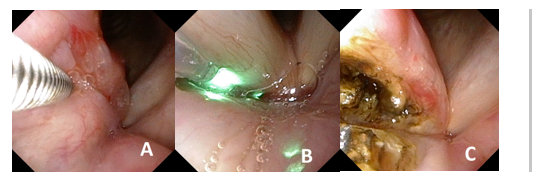
Office- based Diode laser thyroarytenoid myectomy for adductor spasmodic dysphonia-Surgical technique.
Figure 1A -Trans-nasal endoscopic injection of 0.5% Lidocaine into each thyroarytenoid muscle and ventricular fold.
Figure 1B -Application of Diode laser to. thyroarytenoid muscle and part of ventricular fold.
Figure 1C-Completion of Diode laser partial laser thyroarytenoid myectomy and ventricular fold excision
Vaporization was carried out to a depth of 3–5 mm within the thyroarytenoid muscle, targeting the terminal nerve fibers of the thyroarytenoid branch of the recurrent laryngeal nerve. This combined myectomy and neurectomy was intended to prevent reinnervation of the thyroarytenoid muscle. The extent of laser myectomy was defined as follows:
Anteriorly: up to the junction of the anterior and middle third of the thyroarytenoid muscle
Posteriorly: up to the vocal process
Medially: up to the lateral margin of the vocal ligament
Laterally: up to the perichondrium of the thyroid cartilage, guided by tactile sensation
No intraoperative complications were encountered during the procedure.
Adductor spasmodic dysphonia (ADSD) remains a challenging voice disorder, traditionally managed with botulinum toxin injection, which is considered the gold standard. However, the limitations of Botox therapy such as variable duration of benefit, need for repeated injections, and inconsistent voice outcomes have driven the search for alternative interventions.
Surgical approaches, including thyroarytenoid myectomy under general anaesthesia, have been described, but these are often limited by technical challenges such as difficult laryngeal exposure. The present case highlights the feasibility of a transnasal office-based diode laser thyroarytenoid myectomy, which offers several advantages
Minimally invasive: performed under local anaesthesia without the need for general anaesthesia or suspension laryngoscopy.
Cost-effective: avoids repeated Botox injections and operating room expenses.
Safe and well-tolerated: no intraoperative or postoperative complications were observed.
Sustained voice improvement: the patient demonstrated marked reduction in hyperadduction and voice breaks, with VHI-10 improving from 30 to 12, and stable voice maintained for one year.
The inclusion of ventricular fold resection further reduced supraglottic hyperadduction, enhancing the long-term stability of results. By combining myectomy with neurectomy of terminal thyroarytenoid nerve fibers, the technique addresses both muscular and neural contributors to ADSD, potentially reducing recurrence.
Even though many of the surgical procedures described earlier for adductor spasmodic dysphonia reported longer symptom free period than Botox therapy, most of the authors reported that symptoms returned in few years.2,3,5,11 In such situations patients may have to resume either to botulinum toxin injection or to redo surgery for the management of symptoms. When redo surgery is indicated, the present technique which is simple, cost- effective, can easily be performed as an outpatient procedure. It is also a better option for patients who do not want to accept scar that can occur in trans-cervical surgical procedures described for adductor spasmodic dysphonia.
The limitations for the present technique are, difficult to apply in patients with severe anxiety or gag reflex and also in patients associated with head and neck movement disorders.
The exact aetiology of adductor spasmodic dysphonia remains uncertain. Current treatment modalities are directed toward denervation of the intralaryngeal muscles, either through botulinum toxin (Botox) injection or surgical intervention. The surgical technique described in this report is only a preliminary observation that offers several advantages over earlier methods: it is minimally invasive, safe, cost-effective, simple to perform, and feasible even as a redo procedure.
This innovative office-based diode laser thyroarytenoid myectomy represents a ray of hope promising alternative to Botox therapy, particularly for patients with poor response to injections or those seeking a more durable solution. Until the central neurological abnormality responsible for laryngeal muscle spasms is fully identified and targeted, such office-based procedures may serve as effective interim therapies.
Future studies involving larger patient series and long-term follow-up are essential to validate the efficacy of this technique, establish its limitations, and develop guidelines for appropriate patient selection to optimize surgical outcomes.
None.
The author declare that they have no competing interest or funding

©2026 Phaniendra, et al. This is an open access article distributed under the terms of the, which permits unrestricted use, distribution, and build upon your work non-commercially.