MOJ
eISSN: 2576-4519


Mini Review Volume 9 Issue 1
 Romero-Ángeles B, Trejo-Enríquez A, Rodríguez-Granados E, Martínez-Reyes J, Gallegos-Funes FJ, Velázquez-Lozada E, Martínez-Mondragon M, Laguna-Canales AS
Instituto Politécnico Nacional, México
Correspondence: Guillermo Urriolagoitia Sosa, Instituto Politécnico Nacional, Escuela Superior de Ingeniería Mecánica y Eléctrica, Sección de Estudios de Posgrado e Investigación, Zacatenco, C.P. 07320, México
Received: October 14, 2025 | Published: October 29, 2025
Citation: Rojas-Castrejon Y, Urriolagoitia-Sosa G, Romero-Ángeles B,et al . Human ribs: structure, function, and mechanical response. MOJ App Bio Biomech. 2025;9(1):100-101. DOI: 10.15406/mojabb.2025.09.00233
The rib cage is an osteocartilaginous and musculotendinous structure that protects vital organs—the heart, lungs, and large vessels—and simultaneously facilitates mechanical ventilation. It consists of the sternum, twelve pairs of ribs (true, false, and floating), and the thoracic spine (T1–T12), integrated by costosternal, costovertebral, and costotransverse joints. The ribs, in particular, can be considered thin-sectioned curved beams composed of cortical and trabecular bone, attached to the sternum by viscoelastic costal cartilage. This architecture provides a unique combination of stiffness and flexibility that allows for impact absorption, load transmission to the spine, and accommodating volumetric changes in the thorax during inspiration and expiration.
Keywords: ribs, biomodel, bone structure, thorax
From a biomechanical perspective, rib behavior is determined by curvature, cortical thickness, trabecular porosity, and the degree of ossification of the costal cartilage—parameters that vary with age, sex, and bone health.
During breathing, bucket-handle and pump-handle movements depend on the coordination between the diaphragm, intercostal muscles, and the mobility of the costal joints, modifying the anteroposterior and transverse diameter of the thorax. Under nonphysiological loads (trauma, focal compression, vigorous coughing in osteopenic bone), the ribs are susceptible to fractures, the location and pattern of which are related to the direction of stress, local geometry, and rate of deformation.
In the clinical setting, chest pain, costochondritis, chest wall instability, and multiple fractures (flail chest) illustrate the diagnostic and therapeutic relevance of understanding their mechanics.
MorfologyThe anterior end of each rib is continuous with the costal (hyaline) cartilage, which is essential for thoracic elasticity. The true ribs (R1–R7) form sternocostal joints; R8–R10 contribute to the costal arch. The costovertebral joints comprise: (a) the articulation of the head of the rib with the vertebral body (usually two contiguous hemifacets except R1, R11, R12), and (b) the costotransverse joint between the costal tubercle and the transverse process of the corresponding vertebra (absent in R11–R12). Radiate, intra-articular, and costotransverse ligaments stabilize these unions.
ProcessAn observational and computational study was conducted to characterize the mechanical response of human ribs and their integration with the rib cage during physiological (quiet and deep ventilation) and non-physiological (vigorous coughing and external loads) scenarios. The methodological flow included: (1) medical image acquisition, (2) 3D segmentation and reconstruction, (3) geometric refinement, (4) meshing, (5) constitutive definition and material assignment, (6) boundary conditions and loads, (7) numerical solution and verification (Figure 1).
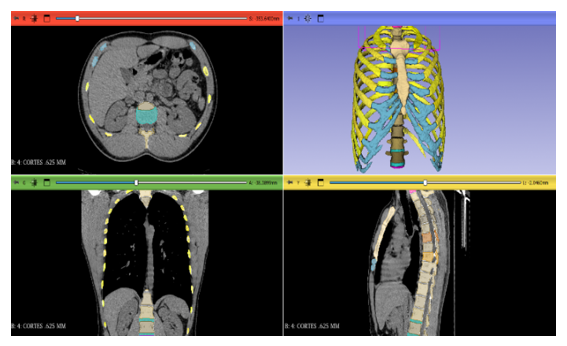
Figure 1 DICOM modeling in 3D slicer® software.
Image acquisition
Computed tomography (CT) scans of the chest (DICOM format) with appropriate slice thickness and FOV were used to define bone and cartilage geometry. When available, magnetic resonance imaging (MRI) was incorporated to refine costal cartilage and soft tissues. Equipment and protocol metadata (manufacturer, model, kVp/mAs, reconstruction kernel, slice thickness, MRI, and TR/TE sequences) were recorded. Data were anonymized prior to processing (Figure 2).
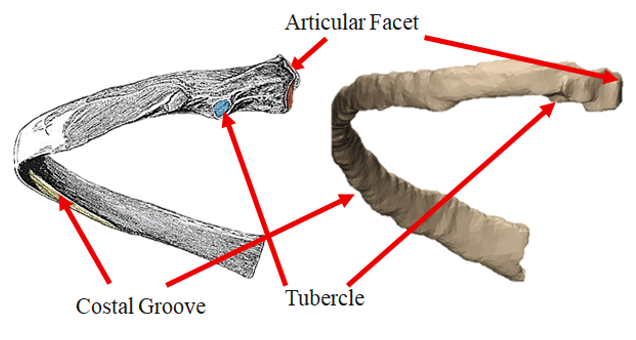
Figure 2 Real structure and biomodel comparison.
Implications for biomechanical modeling
For numerical simulation (finite element method), it is important to represent the anisotropy of the rib bone, the rib-cartilage coupling, and the boundary conditions at costovertebral/sternocostal joints. Contacts should allow for small rotations and sliding, and the cartilage should be modeled as viscoelastic or hyperelastic depending on the loading rate. Loading scenarios include quiet/labored breathing, coughing, Valsalva maneuvers, and upper limb load transfers. Validation can be supported by thoracic pressure-volume curves, videofluoroscopic kinematics, and ex vivo segmental stiffness data (Figure 3 & 4).
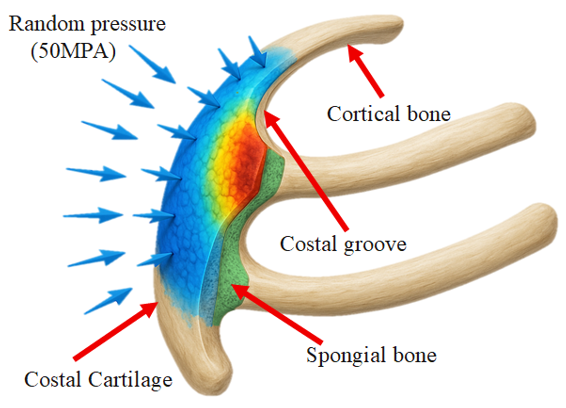
Figure 3 Process of view of how could ribs react to pressure with a random charge (50MPa).
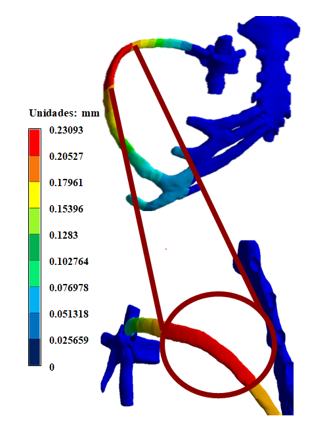
Figure 4 Displacement in X axis.
Analysis of the structure and function of human ribs reveals a thoracic system optimized for combining protection, ventilation, and load transmission. The coexistence of a thin bony cortex with a trabecular core and the transition to costal cartilage confer an anisotropic and region-dependent mechanical behavior, with distinct responses in flexion, torsion, and compression. These material gradients explain both the mechanical efficiency in respiration and the typical failure patterns under impact or overload. Furthermore, variability induced by age (osteopenia/osteoporosis, cartilage calcification) and morphological factors suggests that fracture risk and rib cage stability cannot be assessed with single parameters.
Integrating subject-specific geometry (from CT/MRI) with numerical models and experimental data will allow for more precise estimates of stresses and strains, useful for diagnosis, surgical planning, and fixation device design. Overall, understanding the structure-function-mechanical response relationship in the ribs not only sheds light on thoracic biomechanics but also provides practical approaches for injury prevention and optimizing therapeutic interventions.1–7
The authors gratefully acknowledge the financial support from the Mexican government by de Secretaría de Ciencia, Humanidades, Tecnología e Innovación and the Instituto Politécnico Nacional.
None.
The authors declare that there is no conflict of interest.

©2025 Rojas-Castrejon, et al. This is an open access article distributed under the terms of the, which permits unrestricted use, distribution, and build upon your work non-commercially.