MOJ
eISSN: 2573-2919


Review Article Volume 2 Issue 1
NR Management Consultants India Pvt. Ltd, India
Correspondence: Manoj Kumar Behera, Kalinga Nagar, Bhubaneswar-751003, Odisha, India
Received: October 28, 2016 | Published: March 3, 2017
Citation: Behera MK. Assessment of the state of millets farming in India. MOJ Eco Environ Sci. 2017;2(1):16-20. DOI: 10.15406/mojes.2017.02.00013
With nearly 60 percent of India’s cultivated area is rain-fed, the damage caused by climate change is huge in agriculture sector. In order to save the farmers from such calamities, climate smart agricultural practices are increasingly promoted by government and other stakeholders. Millets cultivation is one such practice which seems to be the answer tofighting climate change, poverty and malnutrition. In this context, this paper presents briefly about India’s shifting approach from paddy and wheat based farming towards millets farming. It also narrates various measures that the government and other stakeholders have undertaken particularly in the last decade to promote millets farming in India.
Keywords: millets, climate change, nutrition, India, farming, consultative, stakeholders
Rainfed farming which covers approximately 60 percent of the total farming area in the country contributes 44% of the total food grain production of the country, produces 75% of pulses and more than 90% of sorghum, millet and groundnut from arid and semi-arid regions.1 Millets are traditionally being grown in rainfed conditions especially by the marginal farmers and tribals. Millets are among the oldest cultivated crops in India and rest of the world. Millets comprise two main groups of species, major millets includes Sorghum and pearl millets and the minor millets are represented by six cultivated species viz. Little millets, Indian barnyard millets, Kodo millet, Foxtail millets, Finger millets, Proso millet. Nearly 60 million acres of land in India are under millet cultivation.2 India is the largest producer of sorghum and millets, accounting for over 80% of Asia’s production.3
In the last few decades, India has evinced a sharp decline in the area under millets due to several factors. The decrease in cultivated area is about 80% for small millets, 46% for finger millet, 59% for sorghum, and 23% for pearl millet. The production of small millets has also decreased significantly from 56.24 in 1960 to 30.52 in 2010,4,5 the father of Green Revolution in India has opined that state policies related to crop loan, subsidies, favourable conditions for commercial agriculture, supply of food items like rice, wheat, maida and rava at reasonable cost through the public distribution system (PDS), have shaped the minds of people to neglect minor millets. The food policies pursued over the years have pushed many people away from millets despite it being more nutritious than rice and wheat.6 The approach of selective utilisation of crops and varieties have reportedly threatened agro biodiversity leading to rapid erosion of natural resources and consequently affecting the nutritional security of people.7
It is the impacts of climate change for which the so far unrecognised millets have received a fair recognition. Global bodies are pushing millets farming with the idea that it reduces agriculture’s carbon footprint while ensuring food and nutritional security. In India and other parts of the world, a growing number of farmers are switching to millets cultivation. The Consultative Group on International Agriculture Research (CGIAR) has suggested that millets are the way forward for countries like India where food security and nutrient security are a major challenge and as water-guzzling wheat and paddy will face tough challenges with temperatures increase due to global warming. CGIAR has estimated that the global production of wheat, rice and maize could decrease by 13 to 20 percent in the coming decades because of climate change. Global agricultural production will have to battle against this loss, even as production needs to rise by an estimated 70 percent to feed the 9 billion people by 2050. In that context, it is noteworthy to mention that against a fluctuating productivity trend in case of major food crops, millets have shown exceptional increase in productivity over the last five decades.4 As India’s agriculture suffers hugely from the vagaries of monsoon, millets which are also known as “famine reserves” for their prolonged and easy storability under ordinary are of great relevance.8 They are most suitable for mixed and intercropping, thus offer sustainable resources use, food and livelihood security to farmers. Additionally, given the fact that millets are very good source of nutrients, developing countries like India which reports dramatic rates of malnutrition (around one fifth of the population) particularly among children and women, promotion of millets farming can help in fighting malnutrition. The 2014 National Council of Applied Economic Research (NCAER) report has revealed the exponential drop in the consumption of hardy millets from 32.9 kg in 1960 to 4.2 kg in 2010 since urbanisation made Indians switch to wheat and rice. Cultivated as dual-purpose crops (food & fodder), millets contribute to the economic efficiency of farming and provide food/livelihood security to millions of households, particularly the small/marginal farmers and the inhabitants of rain fed/remote tribal regions. Research says that a 1% productivity increase could reduce poverty by 0.65% (National Centre for Agricultural Economics and Policy Research Report, 2011). Increasing productivity is more important in rain fed areas as these are 30% less productive than irrigated areas. It seems that millets could be the answer to fighting climate change, poverty and malnutrition.
Importance of millets cultivation
The promotion of millets farming merits attention, particularly from the following perspectives;
From farming perspective: Millets probably provides the best option to the farmers for achieving the triple objectives of farming i.e profitability, adaptability and sustainability. The millets based farming systems have the following advantages;
From human nutrition perspective
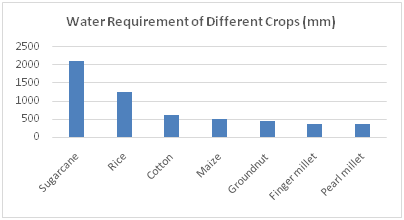
Figure 1 Water Requirement of Different Crops.
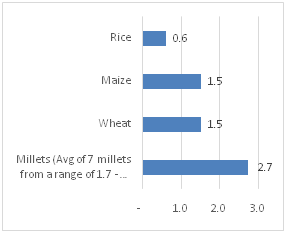
Figure 2 Minerals content in 100 gm of cereals.
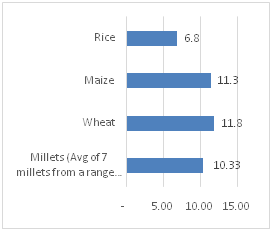
Figure 3 Protein content in 100 gm of cereals.
From environmental perspective
The added advantage of millets cultivation is that it takes into account the concerns of soil and water pollution and climate change.
Millets and Tribal Agriculture: understanding the connections
The tribal communities in India have a unique connection with millets. Millets have been an integral component in their farming systems and the agricultural operations. For example, Soligas, a tribe of BR Hills in Chamarajanagar district of Karnataka celebrate Ragi Habba (Festival) with harvesting of millets.10 Similarly, for most tribals of Madhya Pradesh minor millets of “Kodo” and “Kutaki” have been the largest grown single crop and which form the staple food (Gautam et al, No Year). Patil et al., (2015) have established the role of tribals in conservation of millets. According to a study undertaken by them, millets contributes 50 percent of total germplasms conserved by tribes of Nandurbar district of Maharashtra (Figure 4).Millets find an array of uses among the tribals. Sahu and Sharma have documented the medicinal and other uses of small millets by the tribals of Bastar Plateau Zone of Chhatisgarh, India. As per their study, millets were used for strengthening of mud walls, as fertilizer for onion fields, diseases and insect-pest control, protecting pulses in storage, for baking of earthen pots, treatment of animals and poultry, raising milk productivity in cattle, treatment of burns, etc. and many more uses. The other uses of small millets included, use as snacks, green fodder, medicinal uses, useful in diabetes for lowering of blood sugar, nutritionally superior to other fine cereals, and many more. The Green revolution has also affected tribal agriculture in India. The traditional approach of tribals towards farming and land use has changed a lot mostly due to the influence of state policies which undoubtedly promoted cultivation of selective crops like paddy and wheat. Basavaraj et al. has reported an average decline of 14% in millets cultivation especially from the traditional farming systems.
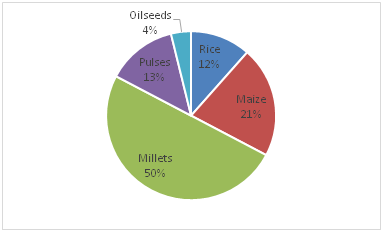
Figure 4 Germplasm conservation by tribes of Nandurbar district of Maharashtra.
Does millets cultivation make a difference?
There are plenty of evidences available in the country to show how millets farming is helping the farmers to cope with the changing situations. Table 1 presents some such evidences around that in India.
Evidences |
Source |
In Medak district of Telengana, which reports the highest |
The Hindu, 2016 |
A farmer from Kogira village of Andhra Pradesh’s |
Bahri, 2016 |
Many farmers in the tribal districts of Odisha like Kandhamal |
ToI, 2016 |
It has been reported that millets were the only crops |
Samuel, 2016, |
Table 1 Learnings from millets farming in India
Government/Civil Society Initiatives
Initiatives of Government of India (GoI)
Government of India has launched a number of programmes to promote millets farming, particularly in the last decade.
State led initiatives
A few states have taken exemplary initiatives to improve both production and consumption of millets.
Civil Society/Other Initiatives
These are a few cases of civil society engagement in promotion of traditional millets farming in India;
The small and marginal farmers in India are facing multiple problems in operating their farms, many of which are systemic and reinforced by other factors in the environment: The farming systems that we need today need to be more resilient and diversified to meet the food and nutrition demands of the nation while ensuring sustainable use of natural resources. It took so any years for the government to recognise the potentials and contributions of millets based farming systems. Though late, GoI and the state governments have taken several progressive measures during the last decade to promote millets farming on a mission mode and increase awareness among the populace particularly the urban Indians for increased consumption of millets. As a result of which, millets are gaining attention and have been prioritized to a greater extent. There are some of the possible areas of intervention for the government and other stakeholders in future.
None.
The author declares no conflict of interest.

©2017 Behera. This is an open access article distributed under the terms of the, which permits unrestricted use, distribution, and build upon your work non-commercially.
